.357 Magnum vs .38 Special: What's the Difference?
The Short Answer: The .357 Magnum and .38 Special use the same .357-inch bullet, but the Magnum runs at much higher pressure for greater velocity, energy, and recoil. Any .357 Magnum revolver can also fire .38 Special, which makes the pair one of the most flexible combinations in the wheelgun world.
Few revolver questions come up more often than .357 Magnum vs .38 Special. The two cartridges look nearly identical, share the same bullet, and often chamber in the same gun. Yet they perform very differently. One is a mild, easy-shooting round trusted for over a century, while the other is a hard-hitting magnum load built for stopping power.
Understanding the .357 Magnum and .38 Special
These two cartridges share the same roots. A quick look at where each one started shows why they seem so alike yet shoot so differently.
A Shared Family Tree
Smith & Wesson introduced the .38 Special in 1898 as a smokeless powder round to replace the older .38 Long Colt. The Long Colt dated to the black powder era and did not give law enforcement the power they wanted. This new smokeless powder cartridge became the standard load for American police and held that spot for decades.
In 1934, Elmer Keith, Phillip Sharpe, and Douglas Wesson built the .357 Magnum on that same case. They lengthened it and loaded it hotter to reach speeds the original round was never designed for. The .357 Magnum earned its title as the first true magnum handgun cartridge, and law enforcement adopted it quickly.
Same Bullet, Different Case
The names are often where the confusion starts. Despite the ".38" label, the .38 Special fires a .357-inch bullet, the exact same diameter the Magnum uses. The old naming style measured the case rather than the bullet. Both are also rimmed revolver rounds, unlike a semi-automatic pistol cartridge such as the 9mm.
The main physical difference is case length. The Magnum case is about one-eighth inch longer than the Special case, which is a deliberate safety feature. That extra length keeps the high-pressure Magnum cartridge from chambering in a gun made only for the lower-pressure .38 Special.
.357 Magnum vs .38 Special: Specs and Performance
The chart below shows how the two stack up. Real numbers make the gap easy to see.
| Spec | .38 Special | .357 Magnum |
|---|---|---|
| Nominal Bullet Diameter | .357 in | .357 in |
| Maximum Case Length | 1.155 in | 1.290 in |
| SAAMI Maximum Average Pressure | 17,000 psi | 35,000 psi |
| SAAMI +P Pressure | 20,000 psi | No SAAMI +P standard |
| Common Bullet Weights | 110-158 grains | 125-180 grains |
| Representative 158-Grain Load | 770 fps | 1,240 fps |
| Muzzle Energy of Representative Load | 208 ft-lbs | 539 ft-lbs |
The final two rows use representative Federal American Eagle factory loads tested with four-inch vented barrels. They are not performance standards for every load.
Pressure and Velocity
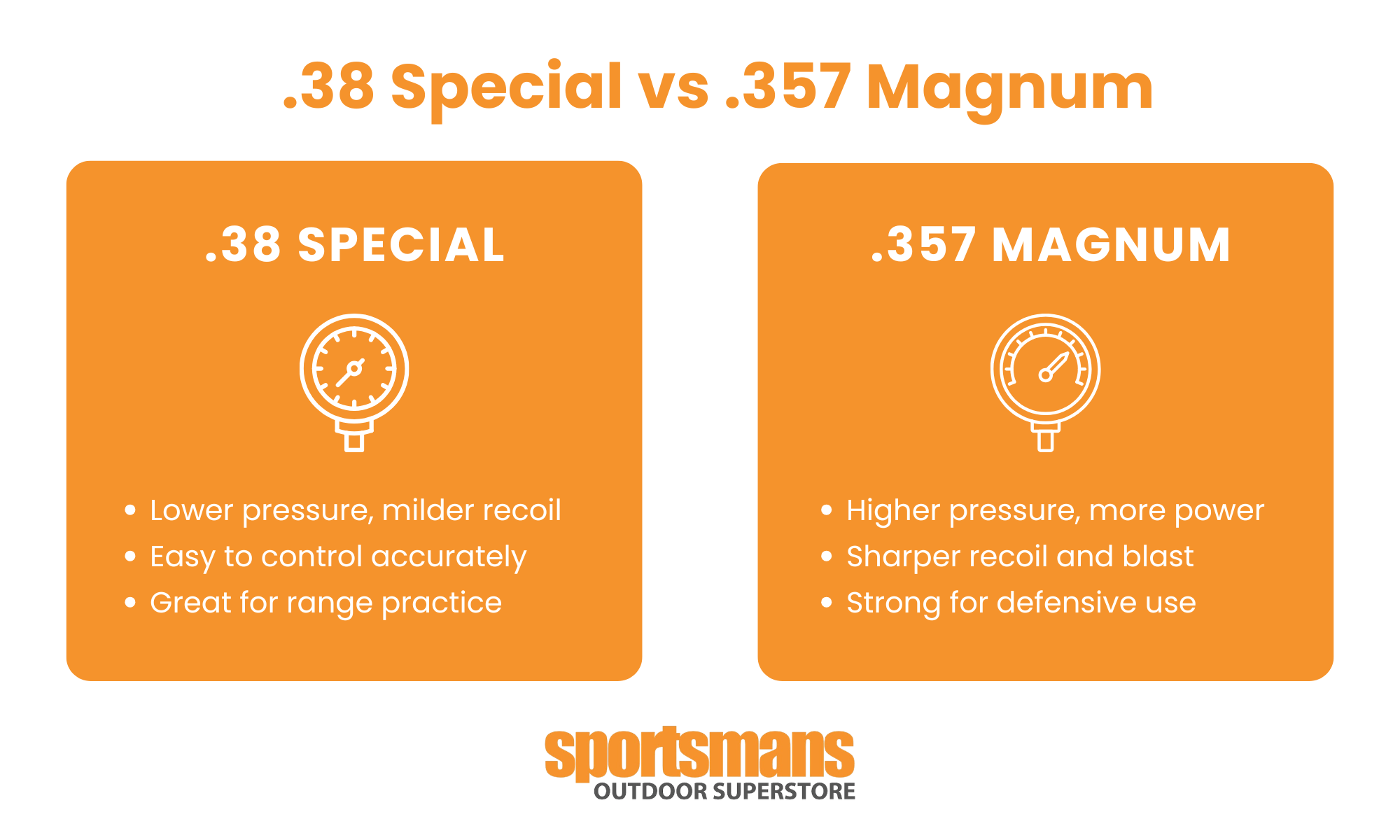
The .357 Magnum operates at roughly 35,000 psi, about double the .38 Special's 17,000 psi, according to SAAMI standards. That high pressure pushes the same bullet at much greater velocity. A Magnum load can push a 158-grain bullet past 1,200 fps, while a standard .38 Special load runs closer to 800 fps. A lighter bullet gains speed, while a heavier bullet adds momentum. More muzzle velocity means more muzzle energy on target and a flatter trajectory at distance.
Recoil and Muzzle Blast
Power comes at a cost. The Magnum produces more felt recoil, flash, and muzzle blast than the Special. New shooters often find the .357 sharp and loud, especially from a short barrel. The .38 Special is milder and easier to control, particularly with a lighter bullet. That is why many shooters train with .38 Special first, then switch to a Magnum load for defense.
Barrel Length Matters
Barrel length affects how completely the powder burns. A short barrel, such as a two-inch snub-nose, can leave powder unburned and lose velocity. A four-inch barrel allows a more complete burn for greater velocity and steadier control. The Magnum gains the most from a longer barrel because it holds more powder, so the right barrel length depends on how you plan to use the gun.
Choosing Between the .357 Magnum and .38 Special
A .357 Magnum revolver can fire both rounds, so you can match the load to the task. Few semi-automatic pistols offer the same flexibility. Here is how they compare across common uses:
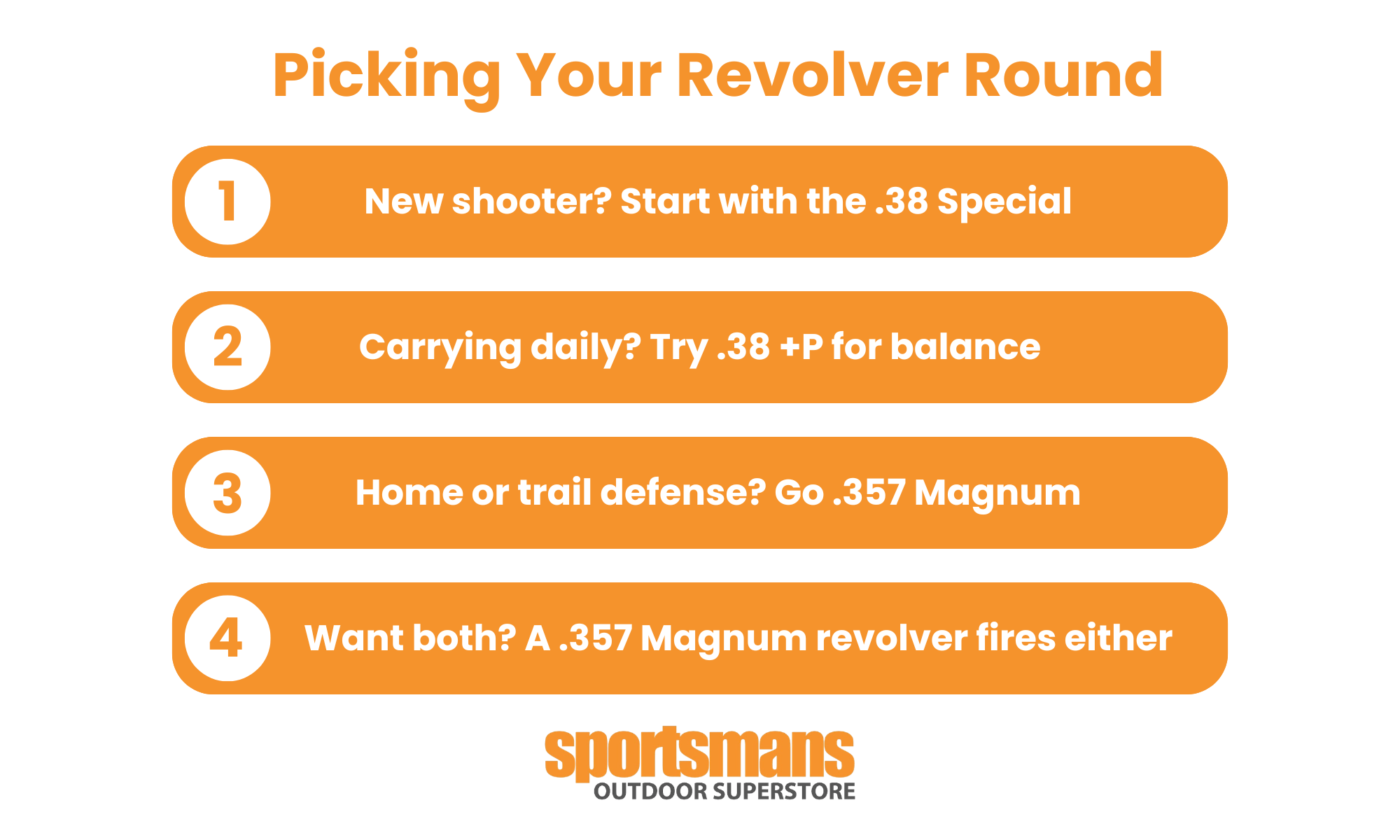
- Self-defense and personal protection: The .357 Magnum delivers more power, while the .38 Special offers lighter recoil for faster follow-up shots. Both perform well with quality hollow points.
- New and recoil-sensitive shooters: The .38 Special is easier to shoot accurately. Its mild recoil builds skill and confidence at the range.
- Concealed carry: Lightweight snub-nose revolvers may chamber either round. Many carriers choose .38 +P ammunition for a balance of power and control.
- Home defense: A Magnum revolver gives you the option of both cartridges. You can keep it loaded with a defensive round that matches your comfort level.
- Hunting and the outdoors: The .357 Magnum is the clear pick for small to medium game and trail defense. Its higher velocity and energy extend its useful range beyond the .38 Special.
- Practice and range time: .38 Special factory ammunition usually costs less than Magnum ammunition, so you can practice more and save the Magnum loads for defense.
The bottom line is that both rounds are solid choices. The .357 Magnum favors power, while the .38 Special favors comfort and control.
Sportsman's Outdoor Superstore: Your Source for .357 Magnum and .38 Special Revolvers
Once you settle on a round, the next step is finding a revolver and ammunition you can count on. Sportsman's Outdoor Superstore carries a wide selection of revolvers chambered in both .357 Magnum and .38 Special, along with .357 Magnum ammunition, .38 Special ammunition, and accessories. Backed by 87 years of firearms experience through the Vance family, our focus is keeping popular calibers in stock and getting your order to you fast.
Frequently Asked Questions
Can a .38 Special revolver shoot .357 Magnum?
No, and you should never try it. A .38 Special revolver is not rated for the higher pressure a Magnum load produces, and firing one could damage the gun or hurt the shooter. The reverse is safe. Any .357 Magnum revolver can fire .38 Special ammunition.
Is the .357 Magnum more powerful than the .38 Special?
Yes. The Magnum runs at roughly double the pressure and pushes the same bullet at much higher velocity. That gives it more energy, a flatter trajectory, and greater power, along with more recoil and blast.
Do the .357 Magnum and .38 Special use the same bullet diameter?
Yes. Both use bullets with a nominal diameter of .357 inches, although bullet weight and design vary by load. The ".38" in .38 Special is a historical caliber designation rather than the bullet's actual diameter.