A Blog for Gun Owners, By Gun Owners

At a Glance: Yes, forced reset triggers are currently legal under federal law. In May 2025, the Department of Justice reached a settlement with Rare Breed Triggers, ending years of litigation and confirming that FRTs are not classified as machine guns under the National Firearms Act. The federal government agreed to stop enforcement actions against FRT owners and return previously seized devices.
The Catch: State Laws Still Vary
While forced-reset triggers are legal in most states, including Ohio, more than a dozen states have passed their own bans. If you own or plan to buy an FRT-15 trigger or similar device, you need to understand both the federal rules and your state's specific laws. This guide breaks it all down.
A forced reset trigger is an aftermarket firearm part that replaces the standard trigger in a semi-automatic firearm, such as an AR-15-style rifle. With a normal trigger, you have to release and pull the trigger manually for each shot. A forced reset trigger speeds up that process by using the bolt carrier group's rearward motion to push the trigger forward automatically after each round is fired.
No. The shooter still has to pull the trigger for each individual round. A forced reset trigger increases the firearm's rate of fire, but the semi-automatic firearm does not become a fully automatic weapon. Each shot is still the result of a separate trigger pull. The most well-known example is the FRT-15 trigger made by Rare Breed Triggers, designed as a drop-in upgrade for AR-15-style rifles.
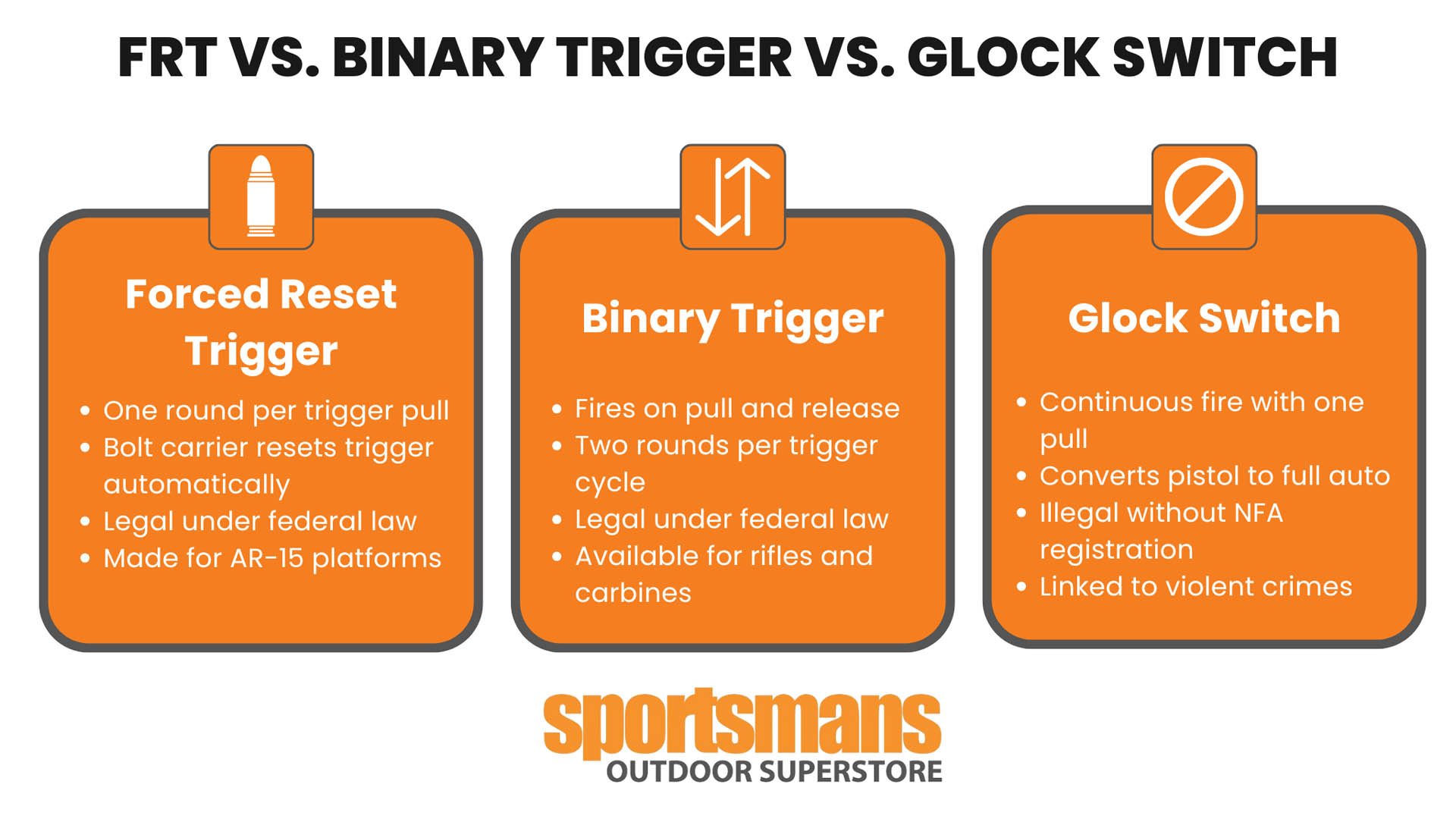
FRTs often get grouped in with other devices that increase a firearm's rate of fire. Here is how they differ:
Forced reset trigger: Uses the bolt carrier to push the trigger forward after each shot for a faster reset. Fires one round per trigger pull. Built primarily for semi-automatic rifle platforms like the AR-15.
Binary trigger: Fires one round when you pull the trigger and a second round when you release it. Available for AR-15s, AK-pattern rifles, and some pistol-caliber carbines.
Bump stock: A stock attachment that uses the rifle's recoil to slide the firearm back and forth against the shooter's stationary finger, simulating rapid fire. The Supreme Court ruled in Garland v. Cargill (2024) that bump stocks are not machine guns under federal law.
Glock switch / auto sear: These are machine gun conversion devices that let a semi-automatic firearm fire continuously with a single trigger pull. A Glock switch can turn a standard pistol into a fully automatic weapon. An auto sear works similarly in rifle platforms. Both are illegal to possess without proper NFA registration and have seen a significant rise in violent crimes in recent years.
A Glock switch or auto sear converts a firearm into a fully automatic weapon and is treated as an illegal machine gun conversion device. Law enforcement agencies have focused on seizing these devices, which are often linked to mass shootings. FRTs, binary triggers, and bump stocks do not convert firearms to full auto, which is why they have been the subject of legal debate rather than blanket federal bans.
As of February 2026, states with laws that ban or restrict FRTs include:
Many of these bans target bump stocks, ghost guns, and other rate-of-fire-increasing devices under broad language that can cover accessories not specifically named.
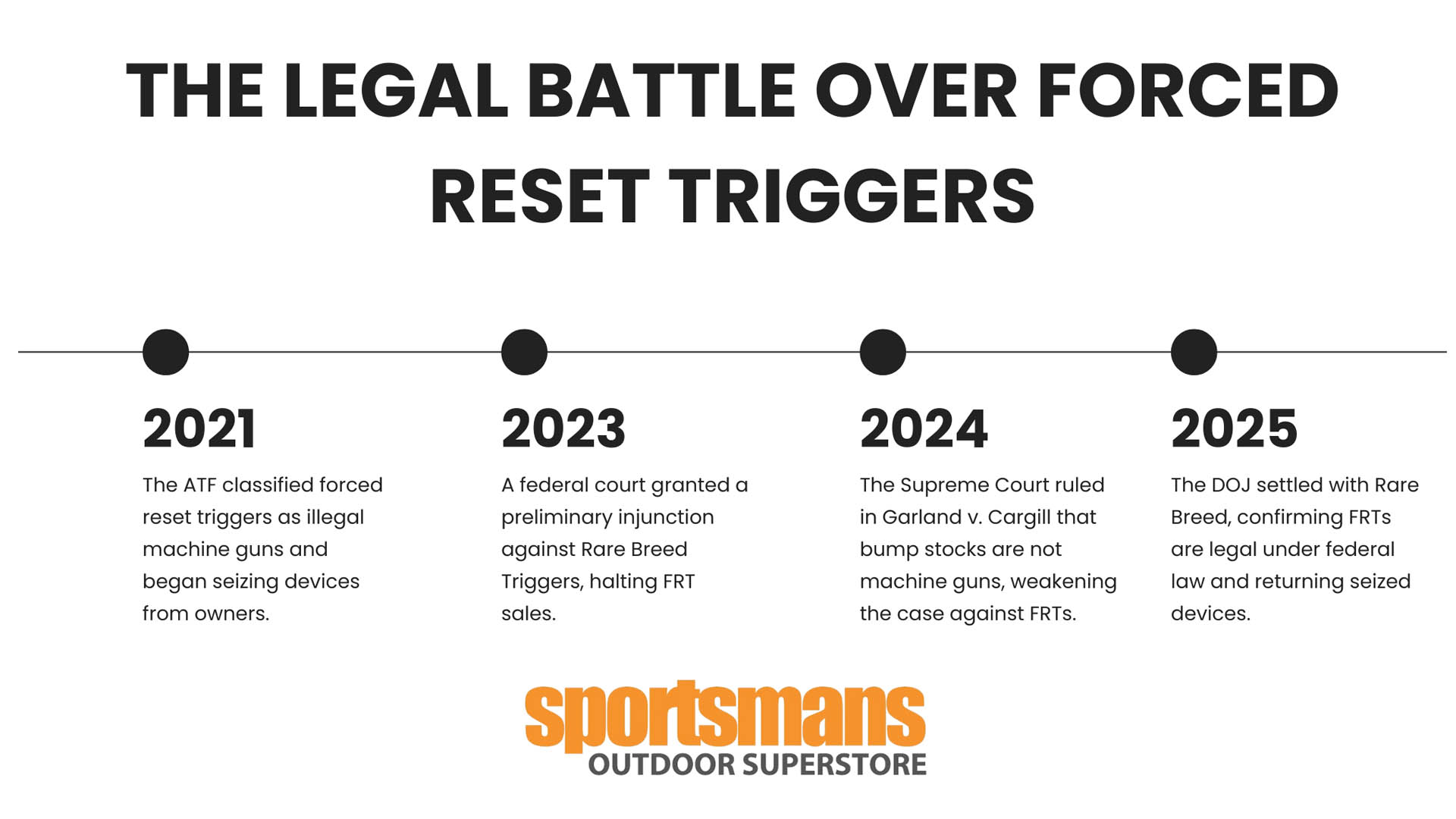
In 2021, the Bureau of Alcohol, Tobacco, Firearms and Explosives (ATF) began classifying certain FRTs as illegal machine guns, arguing they allowed a semi-automatic rifle to fire more than one shot with a single pull of the trigger. The agency issued a 2022 open letter warning all Federal Firearms Licensees against selling FRT-15 triggers. The ATF also pressured individuals to surrender their devices under threat of felony prosecution.
Rare Breed Triggers, once described as the country's largest purveyor of forced reset triggers, fought back with lawsuits. The National Association for Gun Rights (NAGR) also filed challenges, arguing the ATF had overstepped its authority. In 2023, a federal district court granted the government a preliminary injunction against Rare Breed, temporarily stopping sales. But the fight continued through court filings and appeals.
In June 2024, the Supreme Court ruled on Garland v. Cargill. This case dealt with bump stocks, but its impact on FRTs was huge. In a 6-3 decision, the Court held that a bump stock does not make a semi-automatic rifle a machine gun because it does not fire more than one shot by a single function of the trigger. If bump stocks did not meet that definition, the argument for classifying FRT-15 triggers as machine guns became even weaker.
In July 2024, U.S. District Judge Reed O'Connor vacated the ATF's classification of FRTs. Then, on May 16, 2025, the Department of Justice announced a settlement resolving all pending lawsuits. The settlement cited President Trump's Executive Order on Protecting Second Amendment Rights. According to the NRA-ILA's summary of the settlement, the federal government agreed to:
Rare Breed agreed not to produce or market FRTs for handguns where the magazine loads into the grip.
The settlement was a clear win for gun rights advocates, but the landscape continues to evolve. As of early 2026, other manufacturers have begun selling FRTs for handguns, raising new concerns and questions about the scope of the original agreement. In January 2026, the ATF filed a "Statement of Interest" in a patent case between Rare Breed and a competing manufacturer, signaling ongoing interest in how FRTs spread through the market. Those who oppose FRTs point to the gun violence epidemic and illegal plans to use these devices in crimes as reasons for tighter regulation. Congress could still pass legislation that changes the rules.
Yes. Ohio does not have a state-level ban on forced reset triggers. There is no Ohio law that prohibits the sale, purchase, or possession of an FRT-15 trigger or similar device. Ohio's firearm regulations follow federal law when it comes to accessories, and since FRTs are legal at the federal level, Ohio residents can lawfully own them.
Ohio has long been a gun-friendly state. The Buckeye Firearms Association welcomed the DOJ settlement as a reasonable outcome that "respects the rule of law." Ohio also passed permitless carry legislation in recent years, reflecting the state's strong Second Amendment stance. Standard ownership rules still apply. Prohibited persons cannot possess firearms or accessories, and using any device in the commission of a crime can lead to enhanced penalties.
While FRTs are legal under federal law and in most states, several states have passed their own restrictions. According to the California Attorney General's office, forced-reset triggers remain illegal in California as "multiburst trigger activators" under state law, regardless of the federal settlement.
A coalition of state attorneys general filed multistate litigation against the federal government in 2025, challenging the DOJ settlement on public safety grounds. That case is still in the courts, so the legal landscape could shift again. If you travel through any of the states listed above, do not transport an FRT-15 trigger across state lines without checking local laws. What is perfectly legal in Ohio could lead to criminal charges in New Jersey or California.
The legal status of forced reset triggers has shifted dramatically, and it could change again. Court filings, new state laws, and action from Congress all have the power to reshape what is legal and where. Stay informed by following trusted organizations like the NRA-ILA and your state's firearms association, and always verify current law before making a purchase.
When you are ready to shop for triggers, firearms, ammunition, and other accessories, choosing the right retailer matters. Sportsman's Outdoor Superstore is one of the longest-running gun shops still active in the United States and has grown into a trusted online destination for firearms, ammo, and outdoor equipment. Their commitment to customer service makes them a go-to source for gun owners who want quality products at fair prices.
Whether you are looking for a new AR-15 trigger upgrade, browsing out full selection of AR-15 parts and accessories, or stocking up on ammo for your next range day, Sportsman's Outdoor Superstore has what you need at prices that make sense.

Mike Thompson is an avid outdoorsman and firearms enthusiast. With years of experience in hunting, shooting sports, and firearms safety, he offers insights on gear reviews, safety tips, and training strategies. When he's not writing, you'll find him exploring new trails, teaching new shooters, or honing his marksmanship.