A Blog for Gun Owners, By Gun Owners

At a Glance: There's no single best handgun for every beginner. Grip, recoil, and controls all feel different from person to person. The best way to find your first handgun is to try a few models at a local range before buying. This guide breaks down what to look for and offers recommendations based on your intended use.
The challenge with selecting your first handgun is that there are dozens of brands, calibers, and styles to choose from. A handgun that works well for concealed carry may not be the best choice for range practice, and a compact pistol that fits in your pocket might be too snappy for a new shooter to handle confidently. The right handgun for you depends on feel and your intended use: target shooting, home defense, or personal protection.
Not every handgun works well for a first-time buyer. Some kick too hard. Others have controls that take an engineering degree to figure out. The best first handgun balances shootability, safety, and reliability.
Your first handgun needs to work every single time you pull the trigger. A gun that jams at the range is frustrating. A gun that jams during a home invasion could cost you your life. Stick with established manufacturers like Glock, Smith & Wesson, and Sig Sauer. These companies have decades of proven performance, and their handguns have been tested by millions of shooters in real-world conditions.
Recoil matters more than most new shooters realize. A handgun that kicks hard will make you flinch before you even pull the trigger. That flinch destroys accuracy and can make range sessions miserable. Start with a caliber that lets you focus on the fundamentals: stance, grip, and trigger control.
A full-size 9mm feels noticeably softer than a pocket pistol in the same caliber because the extra weight absorbs more recoil energy.
Grip fit matters just as much as recoil. Your hand needs to wrap around the grip naturally, with your trigger finger reaching the trigger without stretching or cramping. Ignore brand loyalty here. A Glock that fits your buddy's hand perfectly might feel awkward in yours. Try before you buy whenever possible.
Look for these grip features:
Simple controls let new shooters focus on marksmanship instead of fighting their firearm. Look for intuitive magazine releases, easy-to-reach slide stops, and controls that work the same way every time.
Most beginner-friendly handguns include trigger safeties, loaded chamber indicators, or manual safeties. The National Shooting Sports Foundation offers free resources on firearm safety basics if you want to dig deeper.
Handguns fall into two main categories: semi-automatic pistols and revolvers. Both have their place, but they work differently.
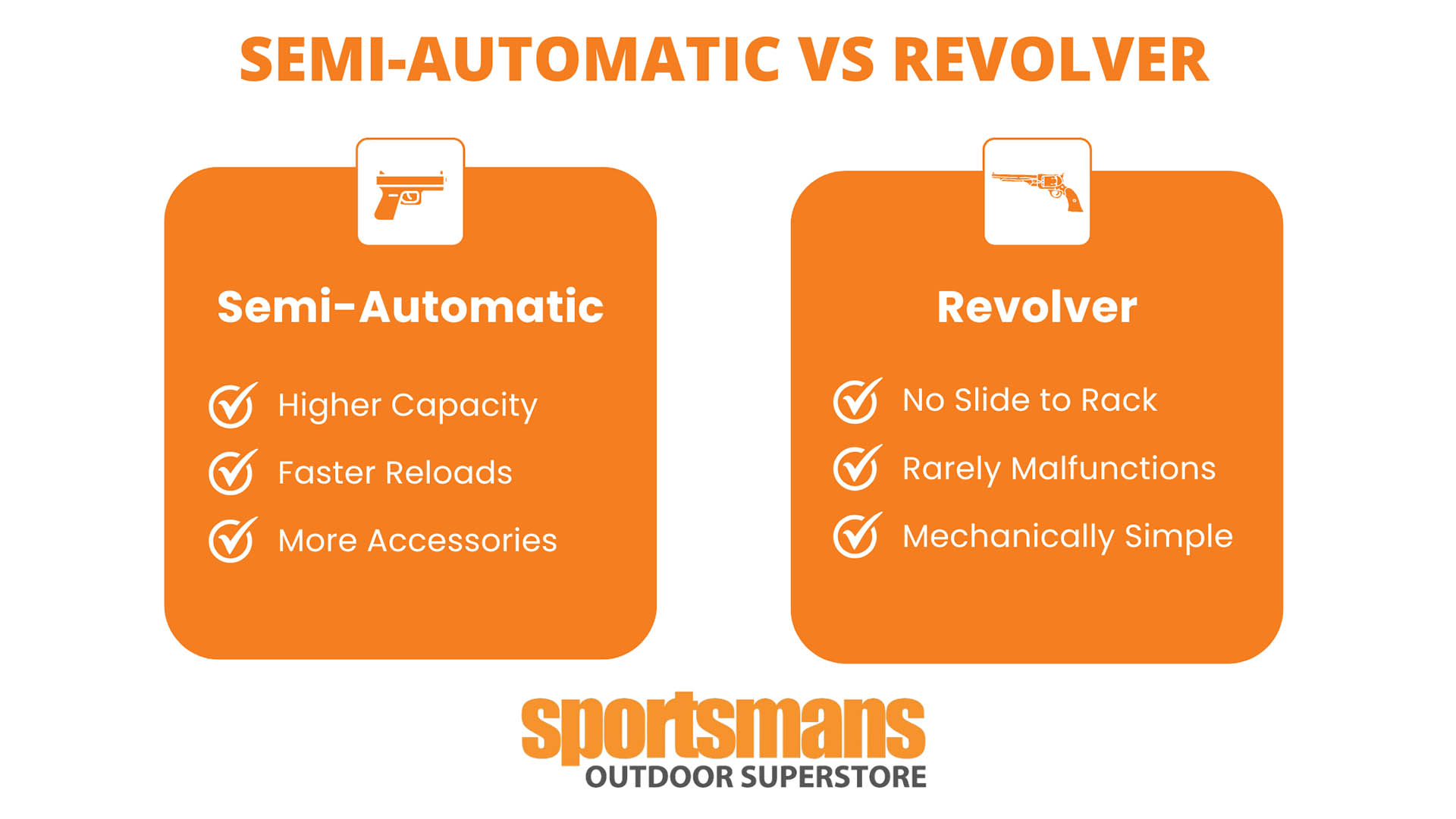
Semi-automatics use the energy from each fired round to eject the spent casing and chamber the next one. Most modern handguns fall into this category. Compared to revolvers, they hold more rounds and reload faster. You'll also find massive aftermarket support for holsters, lights, and other accessories.
9mm is the go-to caliber for beginners. The recoil won't punish you during long range sessions, and ammunition costs about half what you'd pay for .45 ACP. More affordable ammo means more trigger time without blowing your budget. The round also performs well for self defense.
Revolvers hold rounds in a rotating cylinder. They are mechanically simple and almost never malfunction. Pull the trigger on a double action revolver, and it fires. No slide to rack. No safety to disengage.
That simplicity appeals to some new shooters. The tradeoffs are lower capacity (typically 5-6 rounds) and slower reloads. Snub nose revolvers are popular for concealed carry, but their short barrels and heavy trigger pulls make them tough to shoot accurately. Most instructors recommend against them as a first gun.
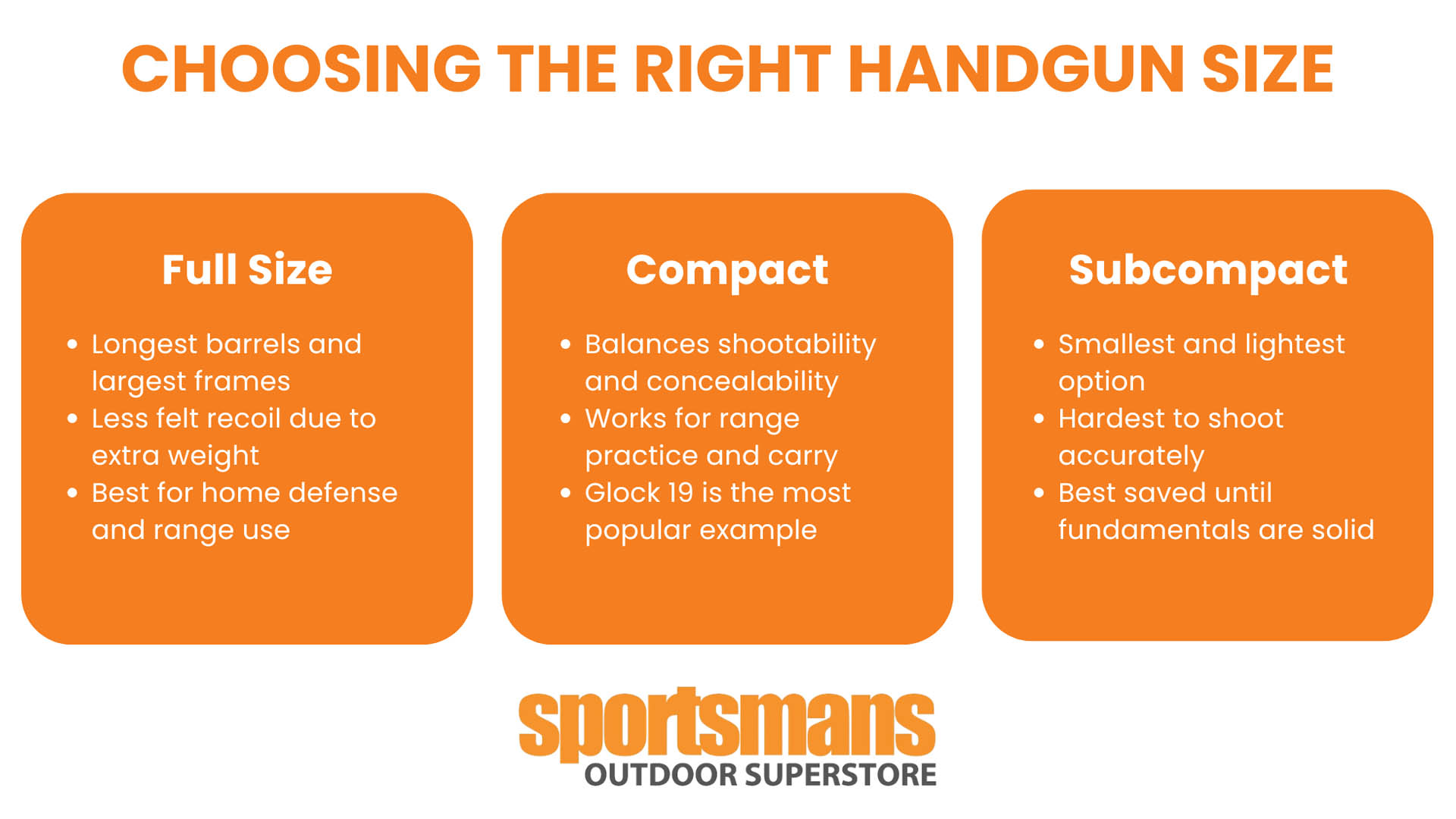
Full size handguns have longer barrels and larger frames. They are the easiest to shoot well. More weight means less felt recoil. A longer sight radius makes aiming easier. If home defense or range shooting is your goal, start here.
Compact pistols split the difference between shootability and concealability. They work well for range practice and can still ride on your hip without printing through your shirt. The Glock 19 falls into this category, which is one reason it gets recommended so often.
Subcompact and pocket pistols are the hardest to shoot accurately. Short grips, snappy recoil, and tiny sights work against you. Learn on a bigger gun first. Once your fundamentals are solid, transitioning to a smaller carry gun is much easier.
Size and type matter, but specific features also affect how easy a handgun is to learn.
Longer barrels mean better accuracy. The sight radius (distance between front and rear sights) increases, which makes precise aiming easier. A 4 to 5 inch barrel works well for target shooting and home defense.
Iron sights come standard on most handguns. Look for sights that are easy to pick up quickly. Many newer models include optics-ready slides, letting you mount a red dot later without sending the gun to a gunsmith. Red dots speed up target acquisition and can help new shooters understand proper sight alignment faster.
Heavy triggers cause accuracy problems. New shooters often jerk the trigger when it has a heavy pull weight, pulling shots off target. Most striker-fired pistols have trigger pulls between 5 and 7 pounds. That weight works well for beginners while still providing a margin of safety.
Magazine capacity varies by model. Some states restrict capacity to 10 rounds, so check local laws before buying. For home defense, more rounds mean fewer reloads if things go wrong.
Buy a popular gun. Seriously. A Glock 19 has thousands of holster options, replacement parts at every gun shop, and YouTube tutorials covering every possible question. An obscure import might cost less upfront, but finding a holster or replacement magazine becomes a headache. Wide aftermarket support makes learning, maintaining, and customizing your handgun much easier down the road.
The NRA provides educational resources on handgun features and selection for new gun owners.
What you plan to do with your handgun should drive your decision. The best choice for punching paper at the range differs from the best choice for nightstand duty.
Nothing beats a .22 LR for learning fundamentals. The recoil is almost nonexistent. You can shoot hundreds of rounds without developing bad habits like flinching. The Ruger Mark IV is a favorite among instructors and hobbyists. Accurate, reliable, and easy to clean.
If you want something that doubles for self defense, look at full size 9mm pistols:
Handle as many of these as you can before buying. The best gun is the one that fits your hand and points naturally when you raise it.
For nightstand duty, a full-size 9mm makes sense. You get the capacity, accuracy, and low recoil without worrying about concealment.
A few features matter more when the gun is meant for protection:
Some shooters prefer stainless steel finishes for corrosion resistance. Others want an optics-ready slide for faster target acquisition under stress. Both are personal preferences rather than requirements.
Choosing your first handgun is a big decision. The retailer you buy from matters almost as much as the gun itself.
Our online store carries handguns from Glock, Smith & Wesson, Sig Sauer, Ruger, Springfield Armory, and other major manufacturers. Need a Ruger Mark IV for target shooting, a Glock 19 for personal protection, or a full size home defense pistol with a rail for your weapon light? We stock all of it at competitive prices.
Ready to buy your first handgun? Browse our full selection of handguns from Glock, Smith & Wesson, Sig Sauer, and more. Stock up on 9mm ammo while you're there. New shooters go through a lot of rounds, and buying in bulk saves money.

Mike Thompson is an avid outdoorsman and firearms enthusiast. With years of experience in hunting, shooting sports, and firearms safety, he offers insights on gear reviews, safety tips, and training strategies. When he's not writing, you'll find him exploring new trails, teaching new shooters, or honing his marksmanship.