A Blog for Gun Owners, By Gun Owners

At a Glance: Rimfire ammo is a type of ammunition where the firing pin strikes the rim of the cartridge base to ignite the primer compound. This design differs from centerfire cartridges, which have a separate primer located in the center of the case head.
The term "rimfire" refers to how the round fires. Manufacturers spread the priming compound inside the rim of the cartridge during production. When you pull the trigger, the firing pin crushes the rim against the barrel's edge, igniting the primer and propelling the bullet forward. This simple, reliable ignition system has been around since the mid-1800s and still sees heavy use today.
Understanding the difference between rimfire and centerfire ammunition helps you pick the right ammo for your firearm and intended purpose. Below, we'll cover how rimfire cartridges work, compare them to centerfire options, and help you choose the best rimfire ammo for your needs.
Rimfire cartridges use a simple but effective ignition system, and the design has remained largely unchanged for over 150 years because it works well for low-pressure applications such as the .22 Long Rifle.
In a rimfire cartridge, the priming compound is spun into the rim of the brass case during the manufacturing process. The rim is thin and hollow, allowing the compound to settle evenly around the base. When you pull the trigger, the firing pin strikes the outer edge of the rim, crushing it and igniting the primer. This small explosion then ignites the powder charge inside the case, sending the bullet down the barrel.
Centerfire cartridges work differently. They use a separate primer seated in the center of the case head. The firing pin hits this primer directly, which then ignites the powder. This design allows centerfire ammo to handle higher pressures and larger powder charges.
One tradeoff with rimfire ammunition is that the cases are not reloadable. When the firing pin strikes the rim, it permanently deforms the brass. There's no way to replace the priming compound or reshape the rim for a second use.
Centerfire cases, on the other hand, use a replaceable primer. Reloaders can remove the spent primer, resize the brass, and load a new primer, powder charge, and bullet. This makes centerfire ammo more economical for high-volume shooters who reload their own rounds. For most rimfire shooters, the low cost per round offsets the inability to reload.
Rimfire and centerfire are the two main types of ammunition, and each has strengths depending on your shooting needs. The differences come down to primer location, pressure handling, cost, and reloadability.
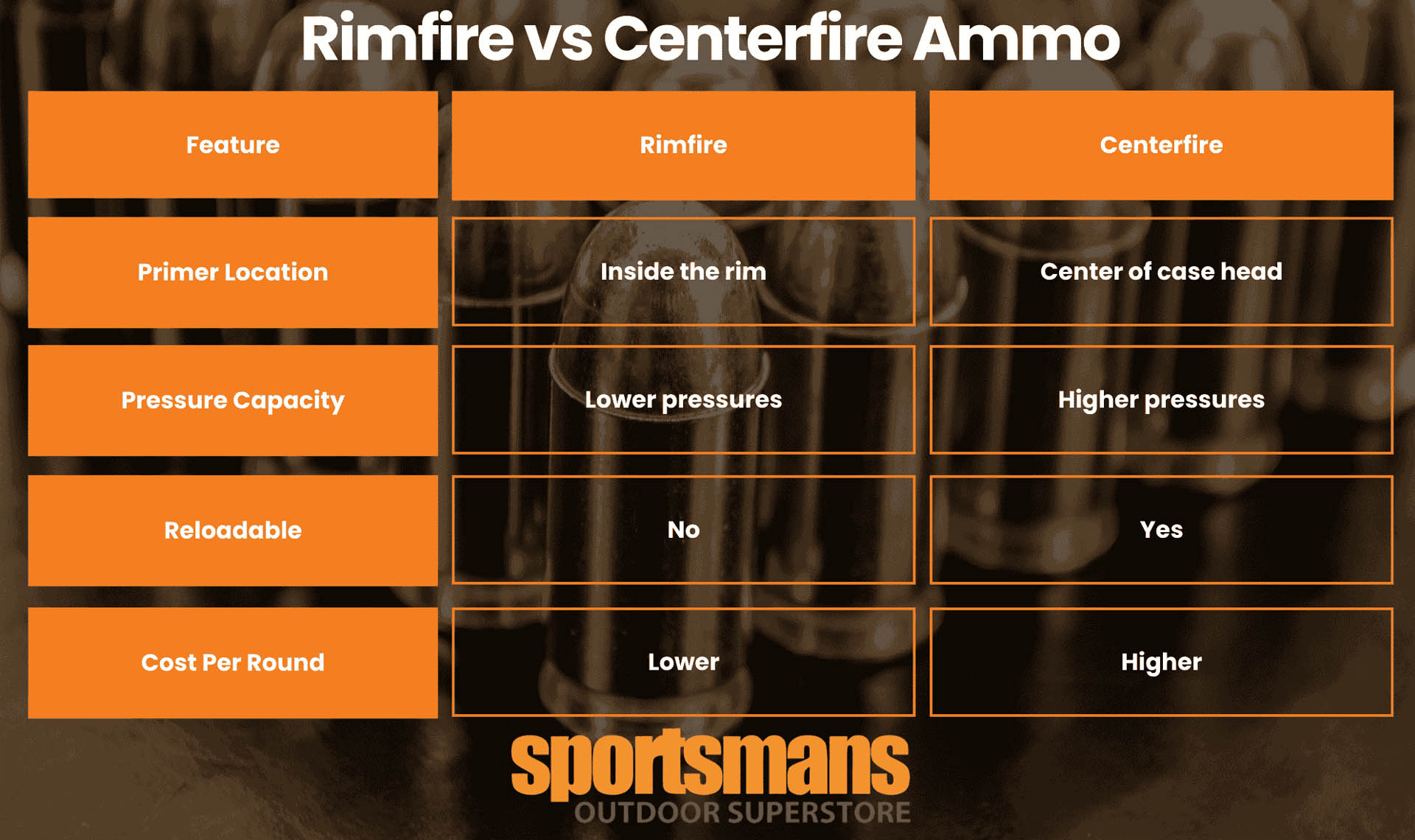
Rimfire cartridges operate at lower pressures than centerfire rounds. A standard velocity .22 LR produces around 1,050 feet per second at the muzzle, while high velocity loads push closer to 1,200-1,300 fps. These speeds work well for plinking and small game at close range.
Centerfire cartridges can handle much higher pressures, which translates to greater muzzle velocity and energy. This makes them better suited for larger game, longer distances, and defensive applications where stopping power matters.
Rimfire ammo is a solid choice for target shooting, plinking, and hunting small game like squirrels and rabbits. The low recoil makes it ideal for training new shooters or spending a long day at the range without fatigue.
Centerfire ammo is the better option when you need more power or range. Deer hunting, home defense, and precision rifle shooting all call for centerfire cartridges. Typically, this is most useful for more experienced shooters due to the increased power and fatigue.
Rimfire cartridges come in several sizes, but a few dominate the market. Each serves a slightly different purpose based on bullet weight, velocity, and intended use.
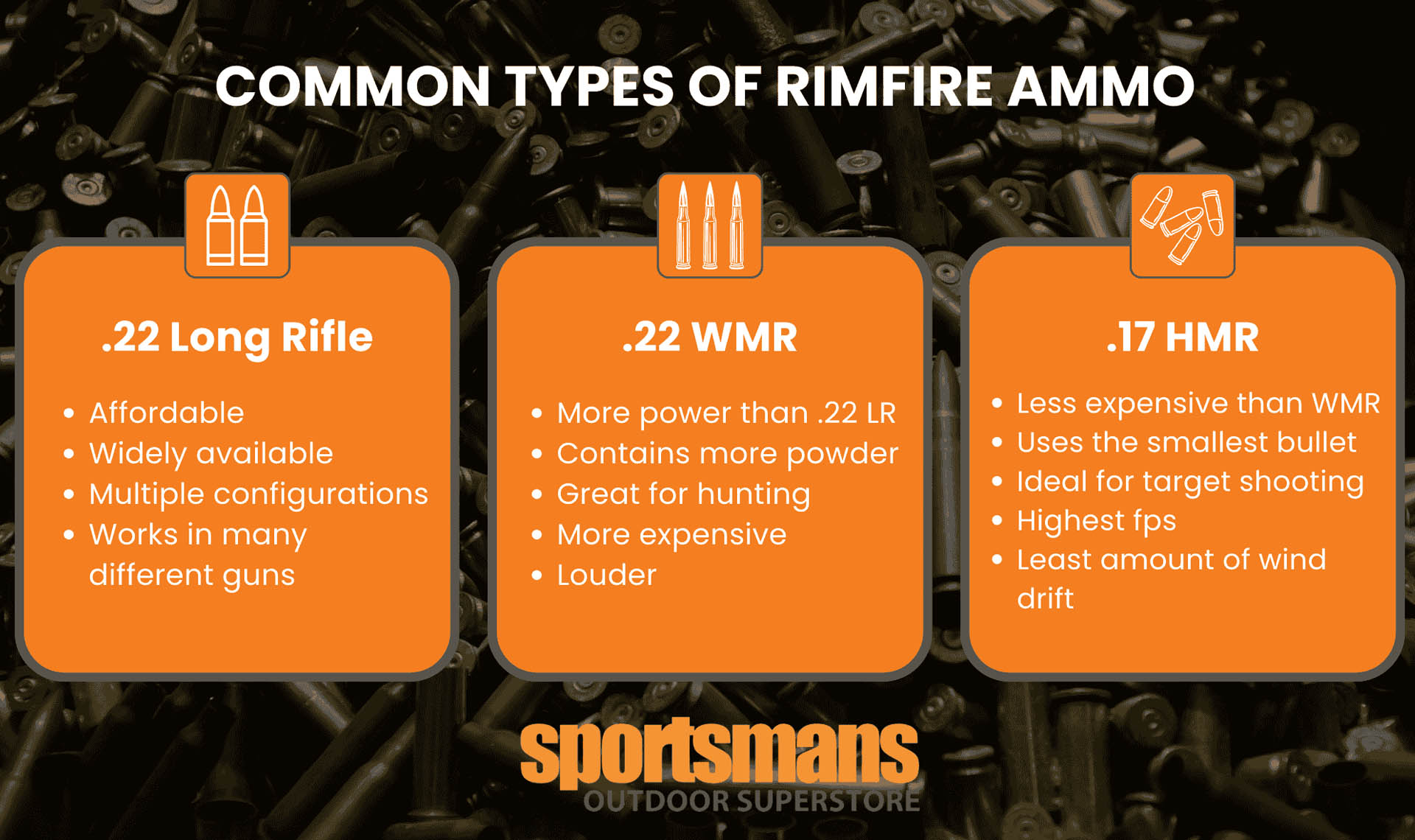
The .22 Long Rifle is the most popular rimfire cartridge in the world. It's affordable, widely available, and works in a huge variety of rifles and handguns. You'll find .22 LR ammo in several configurations:
Standard velocity loads run around 1,050 fps and are quieter with less recoil. Many competitive shooters prefer these for tighter shot groups.
High velocity loads push 1,200-1,300 fps and offer a flatter trajectory for small game hunting.
Round nose bullets are common for target shooting and plinking.
Hollow point bullets expand on impact, making them a better choice for hunting small game.
The .22 WMR delivers more power than the .22 LR. It fires a larger case with more powder, producing muzzle velocities around 1,900-2,200 fps depending on the load. Hunters use it for larger small game like foxes and coyotes, or when they need more reach than a .22 LR provides. The tradeoff is higher cost and more noise.
The .17 Hornady Magnum Rimfire is a newer cartridge that fires a small, lightweight bullet at high speeds. Muzzle velocity typically exceeds 2,500 fps. The flat trajectory and minimal wind drift make it popular for varmint hunting and precision target shooting at longer distances. Ammo cost sits between .22 LR and centerfire options.
Rimfire cartridges fill a specific role in the shooting world. Their low cost, mild recoil, and quiet report make them a practical choice for several applications.
Rimfire ammo is a go-to for recreational shooting. A brick of .22 LR costs a fraction of what you'd spend on centerfire ammo, so you can shoot all day without breaking the bank. The low recoil lets you focus on fundamentals like trigger control and sight alignment without developing a flinch.
For competitive shooters, match-grade ammo offers tighter tolerances and more consistent performance. Brands like Eley produce match-specific loads designed to minimize group size at 50 yards and beyond. These rounds cost more than bulk ammo but deliver the accuracy that competition demands.
The .22 LR has been a go-to for small game hunters for over a century. It's effective on squirrels, rabbits, and similar-sized animals at close range. A hollow point bullet provides enough expansion to make clean kills without destroying too much meat.
For slightly larger game or longer shots, the .22 WMR and .17 HMR offer more velocity and energy. Many hunters keep a rimfire rifle specifically for small game season or pest control around the property.
Low recoil and manageable noise make rimfire firearms ideal for introducing someone to shooting. New shooters can learn proper stance, grip, and trigger control without the intimidation factor of a larger caliber. The affordable ammo also means more practice time for the same budget.
Many experienced shooters use a .22 LR trainer to warm up before switching to their centerfire rifle or pistol. It's a low-cost way to reinforce good habits.
Not all rimfire ammo performs the same. The right choice depends on what you're shooting and what you expect from your rounds.
Standard bulk ammo works fine for plinking and casual range days. It's affordable and reliable enough for most recreational shooting. However, you may notice some variation in accuracy from round to round.
Match grade ammo goes through stricter quality control during production. Manufacturers sort rounds by weight and inspect them for consistency. The result is tighter shot groups and more predictable performance. Eley Match and similar premium loads are popular among competitive rimfire shooters who need every advantage at the target.
Bullet design affects how a round performs on impact.
Round nose bullets feed reliably and punch clean holes in paper. They're a standard choice for target shooting.
Hollow point bullets expand when they hit soft tissue, transferring more energy to the target. Hunters favor them for small game.
Lead bullets are the norm for rimfire ammo. Some ranges restrict them, so check the rules before you go.
Ammo packaging tells you more than just the brand name. Look for the velocity rating (standard, high velocity, or subsonic) to match your intended use. The bullet weight, measured in grains, affects trajectory and energy. Most .22 LR loads run between 36 and 40 grains.
Tip: Some shooters track the lot number on the box. If you find a batch that shoots well in your rifle, buying more from the same lot can help maintain consistency.
Rimfire ammunition offers an affordable and practical option for target shooting, small game hunting, and training new shooters. The simple design has stood the test of time, and cartridges like the .22 Long Rifle remain among the most popular rounds in the country.
When choosing rimfire ammo, consider what you're using it for. Bulk ammo works well for plinking and practice. Match grade loads deliver the consistency that competition shooters need. Hollow points are the better pick for hunting. And if you need more power than a .22 LR provides, the .22 WMR and .17 HMR give you extra reach and energy.
Sportsman's Outdoor Superstore carries a wide selection of rimfire ammunition from trusted brands. Whether you're stocking up for a range day or preparing for small game season, you'll find the right rounds at the right price. Browse our rimfire ammo selection and get what you need shipped straight to your door.

Mike Thompson is an avid outdoorsman and firearms enthusiast. With years of experience in hunting, shooting sports, and firearms safety, he offers insights on gear reviews, safety tips, and training strategies. When he's not writing, you'll find him exploring new trails, teaching new shooters, or honing his marksmanship.